
Blackjack basic strategy is the mathematically optimal decision table for every player hand versus every dealer upcard. Follow the correct chart for your table's exact ruleset and you will reduce the house edge to its lowest possible point without counting cards. Here are the highest-impact rules you can apply right now:
- Always split Aces and 8s. No exceptions.
- Never split 5s or 10s. A pair of 5s is a strong double; a pair of 10s is a near-certain winner.
- Stand on hard 17 and above. Every time.
- Double 10 or 11 against any dealer upcard of 9 or lower (and often against 10 on H17 tables).
- Surrender hard 16 against a dealer 9, 10, or Ace when late surrender is available.
- Never take insurance. It is a negative expectation bet that increases the house edge regardless of what your hand looks like.
Pro Tip: Memorise the six rules above before touching the full chart. They recoup the largest share of avoidable EV loss and cover the situations beginners misplay most often.
Table of Contents
- What basic strategy is and why it matters at Canadian tables
- Which basic-strategy chart you need: S17, H17, decks, and payout
- How to play hard totals: rules you can memorise quickly
- How to play soft totals (hands with an Ace counted as 11)
- How to split pairs: when to split and when not to
- Doubling down and surrender: the high-value plays
- Rule variations that change basic strategy and what to watch for
- Common mistakes, the limits of basic strategy, and what to learn next
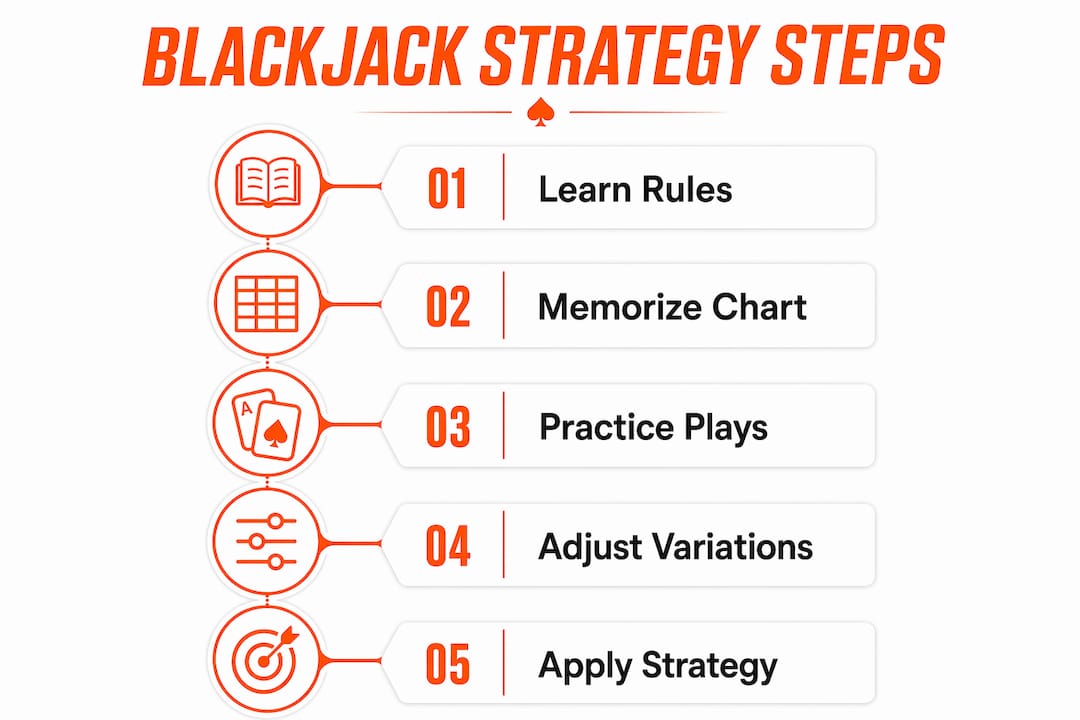
- Practice and memorization techniques: drills and daily routines
- Quick cheat sheet: essential rules to keep at the table
- Key takeaways
- Why basic strategy is misunderstood more than it is misplayed
- Put your chart knowledge to work on Mostbetsignup
- Useful sources and further reading
What basic strategy is and why it matters at Canadian tables
Basic strategy is a lookup table produced by simulating billions of hands and identifying the play that maximises expected value for every possible combination of player hand and dealer upcard. It is not a hunch system or a betting progression. It is the mathematically solved answer to a well-defined problem.
On a common six-deck H17 DAS LS table with perfect play, the house edge drops to roughly 0.47%. Play by gut feeling instead and you are typically handing the house a significantly higher percentage of the wager. That gap is the entire practical argument for learning the chart.
Two things basic strategy cannot do: guarantee a winning session or overcome a negative expected value in the long run. Variance is real, and even perfect play means you are still playing a game where the house has a small edge. Basic strategy minimises that edge; it does not eliminate it.
Canadian players face an additional wrinkle. Rule sets vary by province and by property. Ontario's regulated online market, land-based casinos run by the OLG, and private First Nations venues each tend to use different defaults for soft-17 rules and blackjack payouts. Choosing the wrong chart for your table costs you before you even sit down.
Which basic-strategy chart you need: S17, H17, decks, and payout
Every basic-strategy chart is only optimal for its exact ruleset. Using the wrong one immediately gives back part of the advantage you are trying to capture. Before you bet a single chip, run through this quick table-side check:
- Blackjack payout first. If the table pays 6:5 instead of 3:2, the house edge jumps sharply. Walk away if you can; no chart fully compensates for a 6:5 game.
- S17 or H17? Check whether the dealer stands or hits on soft 17. This single rule changes several strategy cells and adds roughly 0.20% to the house edge when the dealer hits.
- DAS? Confirm whether doubling after a split is allowed. It affects which pairs you split.
- Late surrender? Ask the dealer or check the felt. Surrender availability changes a handful of high-impact plays.
- Number of decks? Single-deck and double-deck charts differ meaningfully from six-deck and eight-deck versions.
The two charts most Canadian players should learn first are the 6-deck S17 DAS LS 3:2 chart and the 6-deck H17 DAS LS 3:2 chart. Most land-based Canadian casinos default to six-deck shoes, and the S17/H17 split is the most common variation you will encounter between properties.
Pro Tip: If you genuinely cannot confirm whether the dealer hits soft 17, use the H17 chart. It is the more conservative assumption and will never cost you more than the S17 chart would in an S17 game.
Charts are divided into three blocks: hard totals, soft totals, and pairs. Find the intersection of your hand row and the dealer's upcard column and that cell is your play.
How to play hard totals: rules you can memorise quickly
Hard totals are hands with no Ace, or hands where the Ace must count as 1 to avoid busting. The pattern most players can lock in within a few sessions:
- Hard 8 or less: Always hit.
- Hard 9: Double against dealer 3–6; hit otherwise.
- Hard 10: Double against dealer 2–9; hit against 10 or Ace.
- Hard 11: Double against dealer 2–10 on S17 tables; hit against Ace.
- Hard 12: Stand against dealer 4–6; hit everything else.
- Hard 13–16: Stand against dealer 2–6; hit against 7 through Ace.
- Hard 17+: Always stand.
Three plays beginners miss most often:
Hard 16 vs dealer 10. Most players stand because busting feels worse than losing. The chart says hit (or surrender if offered). Hitting is the lesser loss; the dealer is already in a strong position.

Hard 12 vs dealer 4. Feels like you should hit because 12 is weak. The chart says stand. The dealer's 4 is a bust card; let them take the risk.
Hard 11 vs dealer 10. Doubling here feels aggressive. It is also correct. You are more likely to land a strong total than the dealer is to beat you with a 10 underneath.
Surrender changes the hard-total picture on a few specific hands. Hard 16 against a 9, 10, or Ace and hard 15 against a 10 are the primary surrender spots. If surrender is not available, revert to the hit line.
How to play soft totals (hands with an Ace counted as 11)
A soft hand contains an Ace counted as 11. The reason you can be more aggressive with soft hands is simple: you cannot bust with one additional card. If the next card pushes you over 21, the Ace drops to 1 and you continue.
The actionable rules:
- Soft 13 (A,2) and soft 14 (A,3): Double against dealer 5–6; hit otherwise.
- Soft 15 (A,4) and soft 16 (A,5): Double against dealer 4–6; hit otherwise.
- Soft 17 (A,6): Double against dealer 3–6; hit otherwise.
- Soft 18 (A,7): Double against dealer 3–6; stand against 2, 7, 8; hit against 9, 10, Ace.
- Soft 19 (A,8) and soft 20 (A,9): Stand. Always.
Two examples worth burning into memory:
A,6 vs dealer 6. Double. You have a soft 17 against the dealer's worst bust card. This is one of the highest-value doubles on the chart.
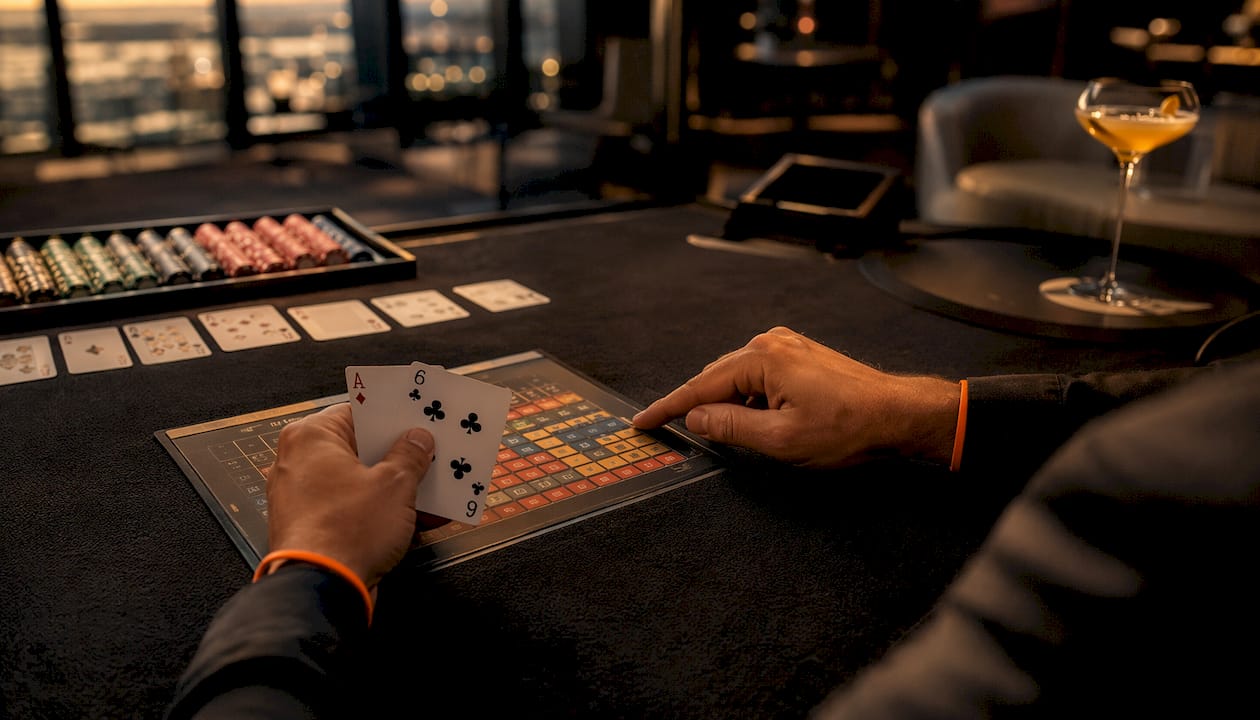
A,7 vs dealer 9. Hit. Soft 18 feels like a strong hand, but a dealer showing 9 is likely to finish with 19. Standing here is one of the most common mistakes recreational players make.
Soft-hand doubles are where passive players bleed the most EV. Hitting a soft 17 or soft 18 when the chart says double is not cautious play. It is leaving money on the table on a hand where the maths clearly favours aggression.
How to split pairs: when to split and when not to
Two rules are absolute, regardless of table conditions:
Always split Aces. Two Aces as a starting hand is weak (soft 12). Two hands each starting with an Ace is a significant advantage.
Always split 8s. Hard 16 is the worst hand in blackjack. Splitting into two hands starting at 8 gives you a path out of a losing position.
The conditional splits depend on the dealer's upcard and whether DAS is available:
- 2s and 3s: Split against dealer 2–7 (with DAS); 4–7 without DAS.
- 4s: Split only against dealer 5–6 with DAS; otherwise hit.
- 6s: Split against dealer 2–6 (with DAS); 3–6 without.
- 7s: Split against dealer 2–7.
- 9s: Split against dealer 2–6 and 8–9; stand against 7, 10, Ace.
Never split 5s. A pair of 5s is hard 10, one of the best doubling hands in the game. Splitting destroys that advantage.
Never split 10s. Hard 20 wins the overwhelming majority of hands. Splitting is giving up a near-certain win for two uncertain ones.
"The most common EV leaks are failing to double and failing to split when the chart dictates. These aggressive plays feel counter-intuitive but are precisely where the maths pays off." — DeucesCracked
Watch for casino restrictions: most tables limit resplits to three or four hands, split Aces typically receive only one card each, and DAS availability directly affects several split decisions. Confirm these rules before you sit.
Pro Tip: Assume DAS is not available unless the table explicitly states it. That keeps your split decisions conservative and prevents you from making a split that only makes sense with DAS.
Doubling down and surrender: the high-value plays
Doubling and surrender are where the chart captures the most EV that casual players routinely leave behind.
Core doubling rules:
- Double 11 against dealer 2–10 on S17 tables; against 2–9 on H17 (the Ace case shifts).
- Double 10 against dealer 2–9.
- Double 9 against dealer 3–6.
- Soft doubles as listed in the soft-totals section above.
Surrender spots (late surrender):
- Hard 16 vs dealer 9, 10, or Ace.
- Hard 15 vs dealer 10.
- On H17 tables, also surrender hard 15 vs Ace and hard 17 vs Ace.
Late surrender means you can only surrender after the dealer checks for blackjack. Early surrender (before the check) is rare in Canadian casinos and more valuable. If a table offers early surrender, the strategy adjustments are significant enough that you should look up the specific chart for that ruleset.
Why does surrender improve EV? On hard 16 vs a dealer 10, you win less than a third of the time when you play it out. Surrendering returns half your bet, which is a better outcome than the expected loss from playing the hand. It is not giving up. It is the mathematically correct choice.
If the table disallows doubling on certain totals, substitute the hit line for those hands and adjust your expectations accordingly. The EV advantage shrinks, but the rest of the chart remains valid.
Rule variations that change basic strategy and what to watch for
| Rule variation | Effect on house edge | Key cells that change |
|---|---|---|
| H17 vs S17 | H17 adds ~0.20% | Soft doubles, some surrender plays |
| 6:5 payout vs 3:2 | 6:5 adds ~1.4% | No chart compensates fully |
| No DAS | Adds ~0.14% | Tightens split decisions (2s, 3s, 4s, 6s) |
| No late surrender | — | Removes hard 15/16 surrender plays |
| Single deck vs six deck | — | Several hard-total and soft-total cells shift |
The 6:5 payout deserves special attention. Many Canadian casinos, particularly at lower-limit tables, have introduced 6:5 blackjack. The chart cannot fix this. A 6:5 game at a table with otherwise excellent rules still carries a house edge well above 1%. If you see 6:5 on the felt, the correct play is to find a different table.
H17 versus S17 is the variation you will encounter most often. The H17 rule flips a handful of soft-double and surrender cells. On an H17 table, for example, you double soft 18 (A,7) against a dealer Ace in some configurations, whereas on an S17 table you hit. These are not large in number, but they matter.
Pro Tip: Prioritise finding S17 tables with 3:2 payouts. Those two rules together represent the largest single improvement to your expected return at a Canadian casino. Everything else is secondary.
Common mistakes, the limits of basic strategy, and what to learn next
The single biggest source of avoidable EV loss is emotional deviation from the chart. Players stand on 16 vs a dealer 7 because they fear busting. They skip a double on 11 vs 10 because it feels risky. They take insurance because they have a good hand and want to protect it. Every one of those decisions costs money.
The other common mistakes:
- Skipping splits and doubles the chart mandates because the extra bet feels uncomfortable.
- Using a six-deck chart at a single-deck table, or an S17 chart at an H17 table.
- Assuming basic strategy will produce winning sessions consistently. It will not.
"Basic strategy is the prerequisite for any advanced advantage play. You should be able to execute it automatically before attempting counting or other advanced methods." — TrainBlackjack
Even perfect basic strategy carries a negative expected value. You are reducing your loss rate to its mathematical minimum, not flipping the game in your favour. Card counting can shift the edge, but it requires a separate and substantial learning investment, and Canadian casinos actively watch for it.
If you want to advance beyond basic strategy, the recommended path is: master the chart to the point of automatic recall, develop consistent bet-sizing discipline, and only then consider studying counting methods. Attempting counting before basic strategy is automatic is a reliable way to make expensive errors on both fronts.
A responsible gambling note: set a session budget before you sit, treat losses as the cost of entertainment, and use resources like Gambling Therapy or GambleAware if gambling stops feeling like a choice.
Practice and memorization techniques: drills and daily routines
Phased memorization is faster than trying to absorb the whole chart at once. Most trainers recommend this sequence:
- Week 1, Days 1–3: High-impact rules only. Aces split always, 8s split always, 5s and 10s never split, double 10 and 11, stand on hard 17+.
- Days 4–5: Hard-total pattern (12–16 vs 4–6 stand; hit vs 7–Ace).
- Days 6–7: Soft totals. Focus on soft 18 (A,7) because it has the most exceptions.
- Week 2: Conditional pairs (2s, 3s, 6s, 7s, 9s), then surrender cells.
- Ongoing: Full chart drills under time pressure.
Effective drills:
- Flashcard runs. Write hand vs upcard on one side, correct play on the other. Drill until you answer in under two seconds.
- Single-cell drilling. If 16 vs 10 keeps tripping you up, drill that one combination fifty times in a row.
- Strategy trainer apps. TrainBlackjack (trainblackjack.app) offers a free browser-based trainer with immediate feedback on every decision. Blackjack Apprenticeship also provides a well-regarded trainer with configurable rulesets.
- Low-stakes live sessions. Online tables with adjustable speed let you pause and check the chart without pressure.
Pro Tip: Fifteen minutes of focused flashcard drilling per day for two weeks is enough for most players to reach dependable recall on the full chart. Spaced repetition matters more than long single sessions. Short and frequent beats long and occasional.
The key to making drills work is immediate feedback. Every wrong answer should be corrected on the spot, not at the end of the session. That is what spaced repetition tools do automatically, and why they outperform passive chart-reading.
Quick cheat sheet: essential rules to keep at the table
Table checks before you sit:
- Confirm the payout is 3:2, not 6:5.
- Confirm whether the dealer hits or stands on soft 17.
- Confirm DAS is allowed.
- Confirm whether late surrender is available.
- Note the number of decks in the shoe.
Hard totals:
- Hard 8 or less: always hit.
- Hard 9: double vs 3–6, hit otherwise.
- Hard 10: double vs 2–9, hit vs 10 or Ace.
- Hard 11: double vs 2–10 (S17), hit vs Ace.
- Hard 12: stand vs 4–6, hit otherwise.
- Hard 13–16: stand vs 2–6, hit vs 7–Ace.
- Hard 17+: always stand.
Soft totals:
- Soft 13–14: double vs 5–6, hit otherwise.
- Soft 15–16: double vs 4–6, hit otherwise.
- Soft 17: double vs 3–6, hit otherwise.
- Soft 18: double vs 3–6, stand vs 2/7/8, hit vs 9/10/Ace.
- Soft 19–20: always stand.
Pairs:
- Always split: Aces, 8s.
- Never split: 5s, 10s.
- Split 2s and 3s vs dealer 2–7 (with DAS).
- Split 4s vs dealer 5–6 (with DAS only).
- Split 6s vs dealer 2–6 (with DAS).
- Split 7s vs dealer 2–7.
- Split 9s vs dealer 2–6 and 8–9; stand vs 7, 10, Ace.
Surrender (late surrender):
- Hard 16 vs dealer 9, 10, Ace: surrender.
- Hard 15 vs dealer 10: surrender.
Universal rules:
- Never take insurance.
- Never take even money on a blackjack.
- Follow the chart. Every time.
Key takeaways
Blackjack basic strategy is the single most effective tool a recreational player has: use the correct ruleset-matched chart, memorise the high-impact plays first, and follow it without exception to reduce the house edge to its mathematical minimum.
| Point | Details |
|---|---|
| Use the right chart | Match your chart to the table's exact rules: S17/H17, deck count, DAS, surrender, and payout. |
| Memorise high-impact plays first | Aces/8s splits, 5s/10s never-split, doubles on 10/11, and the 12–16 pattern cover most EV leaks. |
| Never take insurance | Insurance is a negative expectation bet that increases the house edge regardless of your hand. |
| Basic strategy has limits | Perfect play reduces the house edge to roughly 0.47% on common six-deck H17 tables but does not produce a positive expectation. |
| Mostbetsignup for practice | Mostbetsignup's online blackjack tables let you confirm S17/H17 and payout rules before betting, making it a practical environment to transfer chart drills to live play. |
Why basic strategy is misunderstood more than it is misplayed
Most players who claim to "know" basic strategy have actually memorised a rough approximation of it. They know to split Aces and stand on 17. What they miss are the conditional plays: the soft 18 that needs to be hit against a 9, the hard 12 that should stand against a 4, the surrender on hard 16 vs Ace that they skip because surrendering feels like quitting.
The chart is not complicated. It is precise. Those are different things. A rough approximation of basic strategy still leaves meaningful EV on the table, and the gap between "roughly right" and "exactly right" is widest on the hands that feel most uncomfortable: the doubles, the splits, the surrenders. Those are the plays where the maths is most clearly in your favour and where emotional resistance is highest.
The other misunderstanding is about what basic strategy is for. It is not a winning system. It is a loss-minimisation system. The house still has an edge. What basic strategy does is shrink that edge to a point where your entertainment cost per hour is as low as the game allows without advantage play. That is a meaningful and honest goal.
Put your chart knowledge to work on Mostbetsignup
Online blackjack is one of the best environments to transfer chart drills into real decisions. The game speed is adjustable, the rules are visible in the help screen before you bet, and you can confirm S17/H17, deck count, DAS, and payout in seconds. No guessing, no leaning over to ask the dealer.

Mostbetsignup's platform gives new players a 125% deposit match up to $400 plus 250 free spins with a minimum deposit of just $5 and a promo code at sign-up. That gives you a meaningful amount of practice time at real tables without committing a large bankroll while your chart recall is still developing. Before you play any table, open the game's information panel and confirm the ruleset matches the chart you have memorised.
Claim the Mostbetsignup welcome bonus to get started, or check the signup code page for current promo details. Must be 19+ to play (18+ in Alberta, Manitoba, and Quebec). Gambling is available to Canadian residents where permitted by provincial law. Play within your means. If gambling becomes a concern, contact Gambling Therapy for free, confidential support.
Useful sources and further reading
- TrainBlackjack — Free browser-based strategy trainer with configurable rulesets (S17/H17, deck count, DAS). The best starting point for drilling the chart with immediate feedback.
- CountEdge — Detailed chart explanations for specific rulesets, including the 6-deck H17 DAS LS chart with house-edge figures.
- Vegas Insider Blackjack Tips — Practical tips and strategy overview with clear explanations of why basic strategy works.
- 21Count Basic Strategy Table — Complete reference chart for hard totals, soft totals, and pairs; useful as a printable table-side reference.
- DeucesCracked House Edge Guide — Analysis of where EV leaks occur and why doubling and splitting are the highest-impact plays.
- Casino.org Blackjack Strategy — Covers common mistakes, insurance advice, and disciplined chart execution.
- Gambling Therapy — Free, confidential support for anyone whose gambling is causing concern. Available to Canadian players.
- GambleAware — Responsible gambling resources and self-assessment tools.
- Mostbetsignup — Online blackjack tables with visible rule sets; a practical environment to practise the chart with real hands before visiting a Canadian casino.