
A Draw No Bet (DNB) is a wager on a team to win where a draw at the end of regulation time returns your stake in full. Mostbet lists DNB markets across its soccer catalogue, and Action Network confirms that settlement is based on the 90-minute result plus stoppage time only — extra time and penalties are excluded entirely.
Three outcomes, nothing more:
- Win: your selection wins — you collect the payout.
- Draw: the match ends level — your stake is refunded (a push).
- Loss: your selection loses — your stake is gone.
Table of Contents
- What does draw no bet actually mean?
- How DNB bets are settled: the rules you need to know
- How to convert a 1X2 market into DNB odds
- Draw no bet vs double chance vs Asian handicap
- DNB strategy: when it helps and when it does not
- Common mistakes with DNB and a pre-bet checklist for Canadian bettors
- Key takeaways
- Why DNB is more useful than most bettors realise
- Place your DNB bets on Mostbetsignup
- Useful sources
- FAQ
What does draw no bet actually mean?
DNB removes the draw as a losing outcome. A standard 1X2 football market gives you three ways to lose money; DNB collapses that to two. You back a team, and if the game finishes level, the bet is voided and your money comes back. If your team wins, you get paid. If they lose, you lose.
A quick example: you back Team A at DNB odds of 1.65. Team A wins 2–1 — you win. The match ends 1–1 — your stake is refunded. Team A loses 0–1 — your stake is gone. The terminology is consistent: DNB, Draw No Bet, and Tie No Bet all refer to the same product. The common abbreviation is simply DNB.
DNB pays lower odds than a straight match-winner because the sportsbook is absorbing the draw risk. That cost is baked into the price — you are essentially paying a premium for the insurance.
DNB markets are most common in soccer and other sports where draws are a realistic outcome. In sports that rarely finish level — the NBA, NFL — DNB markets are rare, and some operators do not offer them at all outside select competitions.
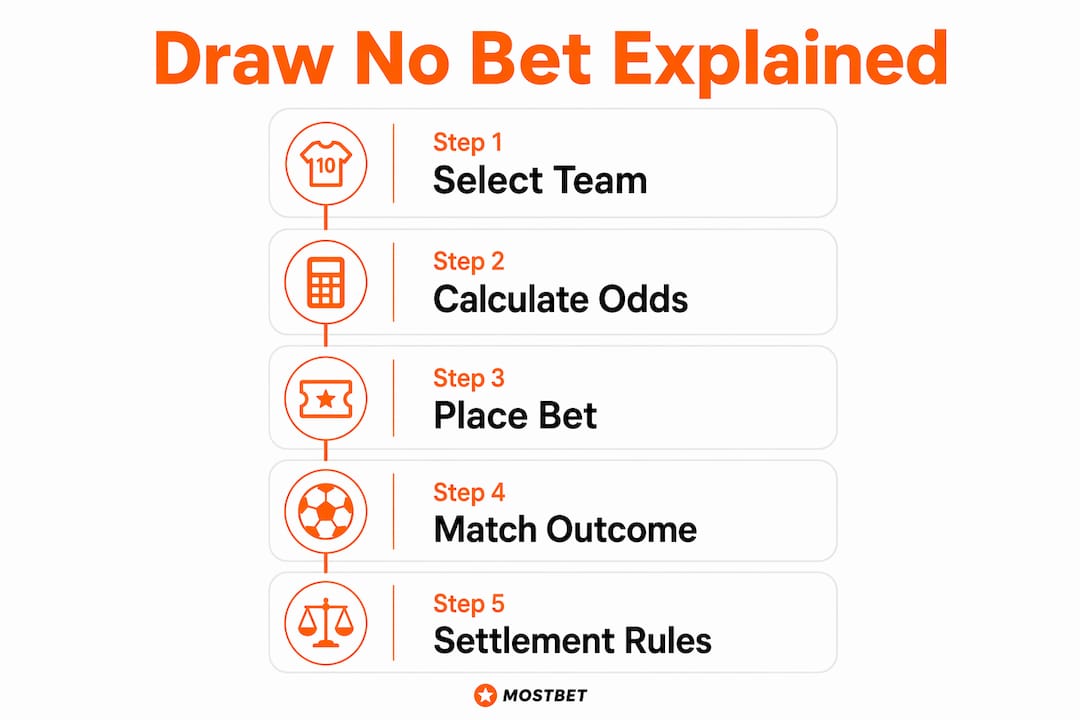
How DNB bets are settled: the rules you need to know
The core rule is straightforward: DNB is settled on the result at the end of regulation time — 90 minutes plus referee-added stoppage. Action Network is explicit on this: even if a team wins in extra time or on penalties, the DNB market is a push if the score was level at 90 minutes.
Key settlement points:
- Regulation time only: 90 minutes plus stoppage decides the bet. Extra time and penalties are irrelevant.
- Abandoned matches: most sportsbooks void the bet and return stakes, but rules vary by operator and competition.
- Postponed or cancelled matches: typically voided; check your operator's specific terms.
- Palpable errors: LegalClarity notes that sportsbooks reserve the right to correct obvious pricing errors or void bets under their standard terms and conditions.
Pro Tip: Before placing a DNB wager, open the sportsbook's settlement rules page and confirm how they handle abandoned matches and bonus-stake exclusions. Operators differ, and a two-minute check can prevent a nasty surprise.
How to convert a 1X2 market into DNB odds
DNB odds are derived by removing the draw from a 1X2 market and rescaling the remaining probabilities. ProbWin outlines the formula as:
P(DNB home) = P(home) ÷ (1 − P(draw))

Convert each decimal odd to an implied probability first (1 ÷ decimal odd), apply the formula, then convert back to decimal odds (1 ÷ renormalised probability).
Here is a worked example using a typical Premier League match:
| Input | 1X2 Decimal Odds | Implied Probability | Renormalised (DNB) | Fair DNB Odds |
|---|---|---|---|---|
| Home win | — | 45.5% | 45.5% ÷ 72.5% = 62.8% | 1.59 |
| Draw | — | — | Removed | — |
| Away win | — | 27.8% | 27.8% ÷ 72.5% = 38.3% | — |
Note: 72.5% = 45.5% + 27.8% (home + away probabilities after removing the draw). Figures are rounded for illustration.
The fair DNB odds for the home side here are 1.59. If your sportsbook is offering 1.50, the margin has eaten into your value. If they are offering 1.65, that is a price worth considering. Comparing sportsbook DNB odds to fair DNB odds derived from a calibrated 1X2 model is the most reliable way to spot value.
Draw no bet vs double chance vs Asian handicap
These three markets all reduce draw risk, but they do it differently and at different prices.
| Dimension | Draw No Bet | Double Chance | Asian Handicap (0) |
|---|---|---|---|
| Best for | Moderate favourites; protected underdogs | Maximum coverage at any price | Value-focused bettors comfortable with handicap markets |
| Settlement (90 min) | Draw = full refund | Draw = win (on 1X or X2) | Draw = full refund (same as DNB at 0) |
| Extra time / penalties | Excluded | Excluded | Excluded |
| Odds trade-off | Lower than 1X2; higher than Double Chance | Lowest odds of the three | Closest to 1X2 match odds |
| Accumulators | Draw voids the leg; acca recalculates | Draw wins the leg; acca continues at full odds | Draw voids the leg; acca recalculates |

Beginners commonly confuse DNB with Double Chance. The difference is meaningful: Double Chance treats a draw as a winning outcome (for example, backing 1X means you win on a home win or a draw). DNB refunds your stake on a draw — you do not win, you just get your money back. Double Chance gives you better coverage but at significantly lower odds. Asian Handicap at 0 is mathematically equivalent to DNB in most cases, though the pricing and margin structure can differ between operators.
Choose DNB when you want refund protection with reasonable odds. Choose Double Chance when you need maximum cover and the lower payout is acceptable. Choose Asian Handicap when you want the closest price to the raw match odds and you are comfortable reading handicap markets.
DNB strategy: when it helps and when it does not
DNB has most value on moderate favourites or underdogs where draw probability is material. On overwhelming favourites at very short prices, the DNB odds barely differ from the straight win price,, so you are paying for insurance you are unlikely to need.
Practical scenarios where DNB adds genuine value:
- A mid-table team hosting a slightly weaker side — draw probability is real, and DNB gives you a sensible safety net.
- An underdog play where you believe the team can hold their own but might not win outright.
- Accumulator legs where a single draw would otherwise kill the entire bet.
On accumulators, a DNB draw voids that leg and the acca is recalculated at the remaining legs' combined odds. Cautious bettors use DNB legs in accumulators to reduce losing scenarios, though each DNB leg compresses the overall payout. Every leg still needs to offer value on its own terms — do not add DNB legs purely for comfort.
Pro Tip: Run the renormalisation formula before placing any DNB bet. If the sportsbook's offered price is materially below your calculated fair odds, the market is not offering value regardless of how safe it feels.
The bankroll implication is worth noting too. A refund is not a profit. If you stake $50 on a DNB and the match draws, you get $50 back — your bankroll is unchanged, but you have not grown it. Plan your staking accordingly.
Common mistakes with DNB and a pre-bet checklist for Canadian bettors
The most frequent error is confusing DNB with Double Chance. They are different products with different payouts. A second common mistake is assuming extra time counts — it does not, and a team that wins in extra time after a 90-minute draw still results in a DNB push.
Other mistakes to avoid:
- Not checking whether bonus stakes are excluded from DNB markets (many sportsbook promotions exclude certain bet types).
- Placing DNB on sports where the market is rarely offered or priced poorly.
- Treating a refund as a win and over-staking the next bet.
Canada-focused pre-bet checklist:
- Confirm the sportsbook settles DNB on 90-minute regulation time only.
- Check the operator's abandoned/postponed match rules.
- Verify DNB is available for the specific league or competition you are betting on.
- If using bonus funds, read the bonus terms to confirm DNB bets qualify.
- Adjust your stake to reflect that a draw returns your money — not a profit.
Key takeaways
Draw No Bet is a two-outcome wager settled at 90 minutes: your selection wins and you collect, the match draws and your stake is refunded, or your selection loses and the stake is gone.
| Point | Details |
|---|---|
| Core settlement rule | DNB is settled at 90 minutes plus stoppage; extra time and penalties are excluded. |
| Odds trade-off | DNB pays less than a straight win bet because the sportsbook absorbs the draw risk. |
| Best use cases | Most value on moderate favourites or underdogs where draw probability is material. |
| Refunds are not profits | A draw returns your stake unchanged; plan staking to reflect this. |
| Mostbetsignup | Mostbet lists DNB markets on its sports betting platform with a $5 minimum deposit and a 125% welcome bonus for new Canadian bettors. |
Why DNB is more useful than most bettors realise
DNB is often dismissed as a cautious bet for people who lack conviction. That framing misses the point. The real use case is not timidity — it is precision. When your probability model shows a match where the draw is genuinely likely (say, 30% or higher), backing a team on a straight 1X2 means you are absorbing a significant chunk of risk for no extra reward. DNB lets you price that risk out and focus your edge on the win/loss binary.
The mistake most bettors make is using DNB as a comfort play rather than a value play. If you have not run the renormalisation formula and compared the result to the offered price, you are not using DNB strategically — you are just paying for insurance without knowing what it costs. Experienced strategists treat DNB as a tactical tool, not a default safety net.
The accumulator use case is genuinely underrated. A single draw in a five-leg acca is the most common way those bets die. Adding one or two DNB legs on matches with high draw probability can meaningfully improve your hit rate without destroying the payout, provided the individual legs still offer value.
Place your DNB bets on Mostbetsignup
Canadian bettors who want to put this into practice will find DNB markets listed in Mostbetsignup's sports betting section. The welcome bonus gives new players a 125% deposit match up to $400, activated with a promo code and a minimum $5 deposit — a low barrier to get started.

Before wagering, check Mostbetsignup's settlement rules for DNB markets and confirm how bonus funds interact with your bets. The withdrawal page explains payout timings for refunded stakes and winnings. Ready to sign up? Claim your welcome offer at Mostbetsignup and find DNB markets under the football section.
Gambling should be entertaining, not a financial strategy. Bet only what you can afford to lose, and use responsible gambling tools if you need them.
Useful sources
- Action Network — "Understanding the Draw No Bet Wager in Football": primary reference for the 90-minute settlement rule and the DNB vs Double Chance distinction.
- ProbWin — "Draw No Bet (DNB): meaning, calculation and betting strategy": source for the renormalisation formula and value-spotting methodology.
- Goal.com — "What is Draw No Bet Betting": odds trade-off explanation and accumulator use cases.
- Goal.com US — "Draw No Bet Meaning": context on sport availability for DNB markets.
- LegalClarity — "What Is Draw No Bet? Definition and Settlement Rules": operator terms, palpable error clauses, and settlement rule guidance.
- Mostbetsignup bonus terms: check how promotional stakes interact with DNB wagers before depositing.
For responsible gambling support in Canada, visit the Problem Gambling Institute of Ontario or contact your provincial gambling helpline.
FAQ
What is a draw no bet example?
You back Team A on DNB at odds of 1.65 with a $100 stake. Team A wins — you collect $165. The match draws — your $100 is refunded. Team A loses — you lose your $100.
How do you win on draw no bet?
Your selection must win the match at the end of regulation time (90 minutes plus stoppage). A draw returns your stake; only an outright win generates a payout.
Is draw no bet worth it?
DNB offers genuine value on moderate favourites or underdogs where draw probability is high. On very short-priced favourites, the odds difference between DNB and a straight win is minimal, so the insurance is rarely worth the price reduction.
Are there risks with draw no bet?
Yes. DNB pays lower odds than a straight win bet, so your upside is capped. A refund on a draw is not a profit. Operators can also void bets under palpable error clauses, so checking settlement terms before staking is worth the effort.
Does extra time count for draw no bet?
No. DNB is settled on the 90-minute regulation result only. If the score is level at full time, the bet is a push regardless of what happens in extra time or on penalties.